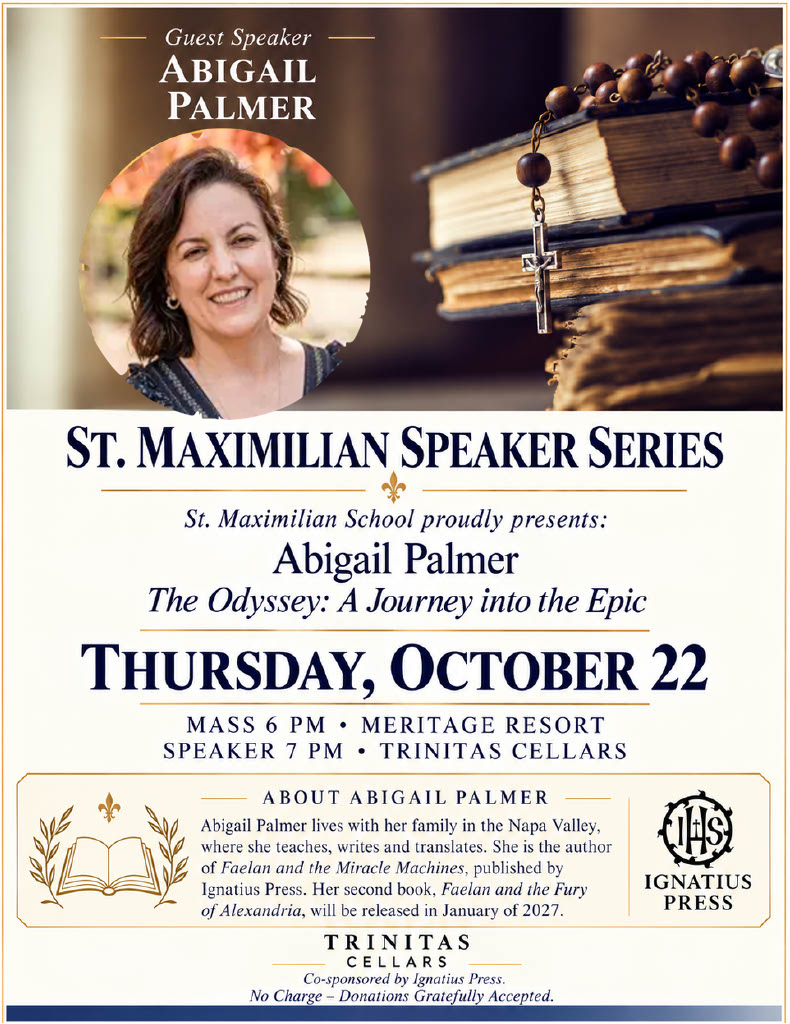
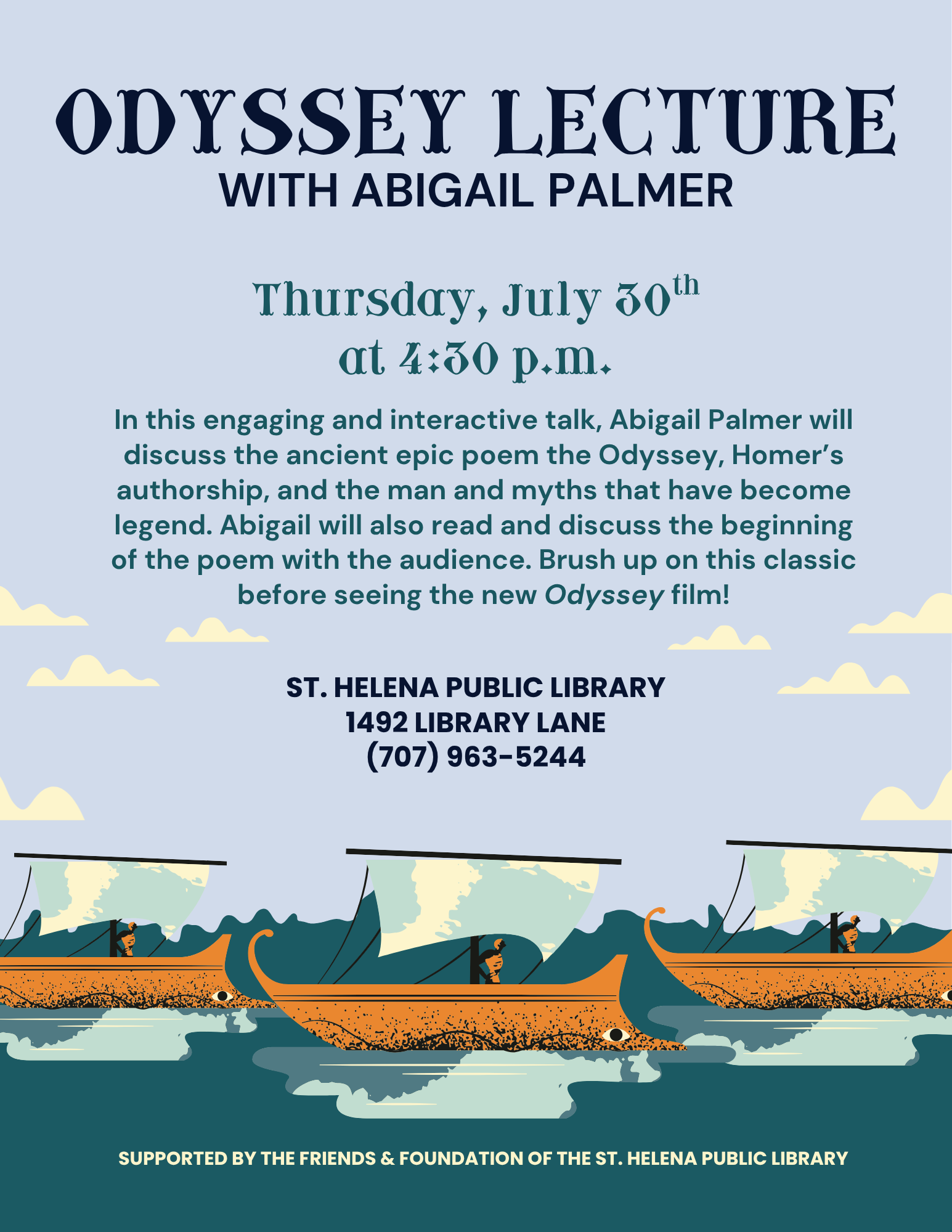
St. Helena Library Talk
Just in time for the new Odyssey film! I always love these talks because St. Helenans bring the best questions. All are welcome!
gradātim…
The double- or triple-booked last weeks of the school year require the preparation of evaluations, both of students and myself, and a look back on all that has passed since September. Reading passages from Virgil’s Georgics with the high school students during harvest time was definitely a highlight for all of us. We actually live in a place where my students know what it means to have hands and limbs stained purple from the freshly pressed wine grapes. One scholar has called the Georgics Virgil’s love letter to the land, just in the disguise of Greek didactic poetry. While reading Virgil together meant detouring from the textbook for a time, it was worth it. We stopped and looked around us.
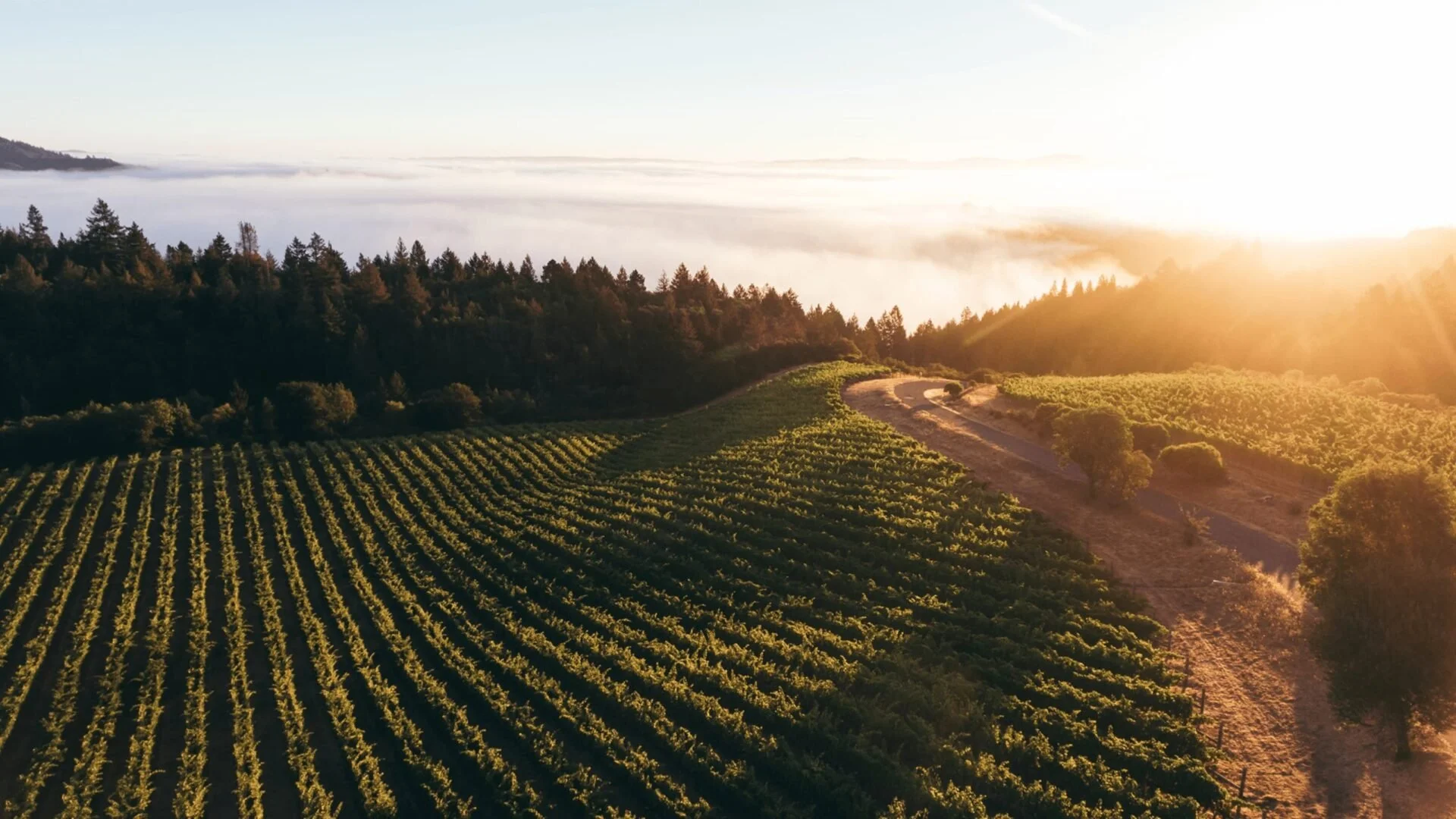
photo taken from https://www.sthelena.com/5-harvest-secrets-in-st-helena/
et varios ponit fetus autumnus et alte
mitis in apricis coquitur vindemia saxis.
And autumn, abundant, yields its variety
And high up the grapes ripen on the sunny slopes.
- Georgics II. 521-522 (translation mine)
While Virgil provided the sublime, ascending to it required a renewed commitment every day, gradātim, step by step, gradually, to teach Latin using as many evidence-based second language acquisition (SLA) principles as possible. Pedagogy!! It’s become a key interest of mine, coming as I do from a Montessori background (someday I hope to create a post where I mash together Latin instruction, Montessori educational philosophy, and SLA acquisition theories, and make something out of it). I suppose it’s worth discussing how I became so interested in language instruction and acquisition, because my journey as a language teacher has been just what I titled this post : GRADĀTIM.
When I first studied Latin, there was really only one way to do it: charts. Lots of charts, memorized, and then some curated sentences that made use of the forms from the charts. Since Latin is a highly inflected language, then the endings are important. And so the charts are a primary feature in each chapter of an older textbook. Here’s one for nouns and adjectives:
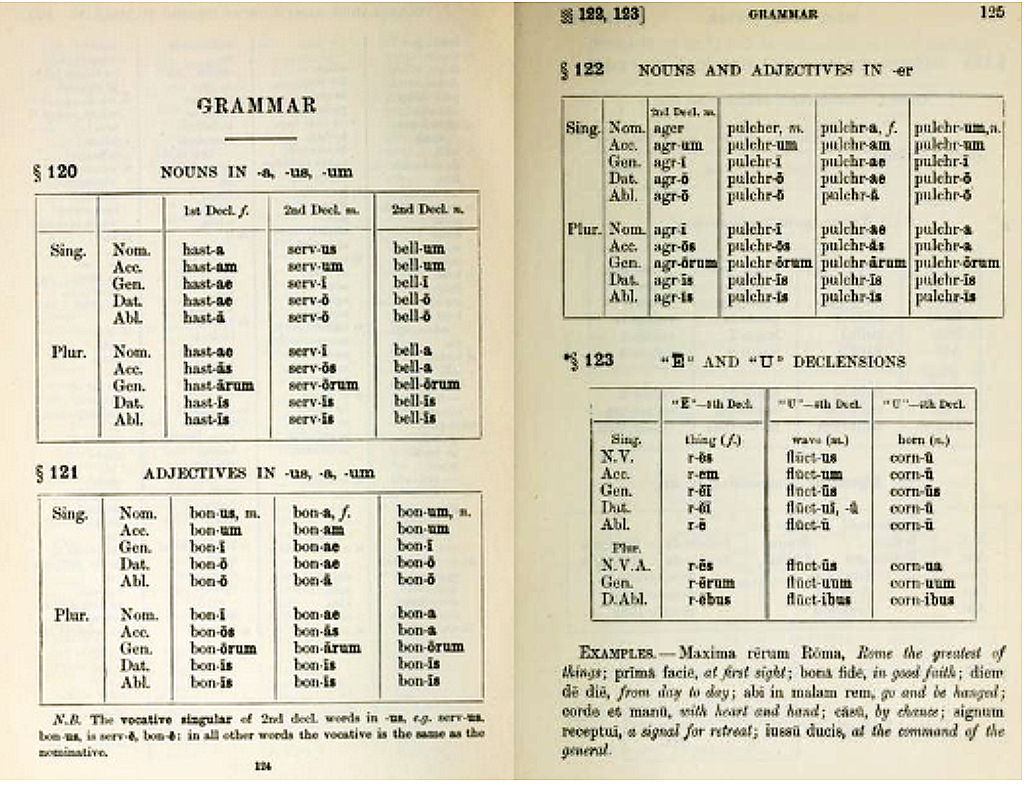
Now, I liked the charts. There were all the possibilities for every noun and adjective, verbs too! Laid out for me. Not that Latin, or ancient Greek, was easy for me- those languages were where I learned to study like I never studied before. But Latin was a code, and I could break it.
Fast forward after years of studying and then teaching Latin and ancient Greek. I was stuck in a rut in my teaching and my students, all of whom had to take Latin, were not all enthusiastic. I mean, there are always a few who seem less interested than others, but the students who were really into Latin looked suspiciously, in their temperaments as students, like….. me.
I was sitting in a tire shop, bored, waiting to get new tires on the car. I turned to my phone and somehow (maybe the rubber fumes from the tires?) discovered Comprehensible Input (CI) and active Latin through an article that popped up from some Facebook group. It was the first of many providential reads that would change how I taught Latin, and it began like this:
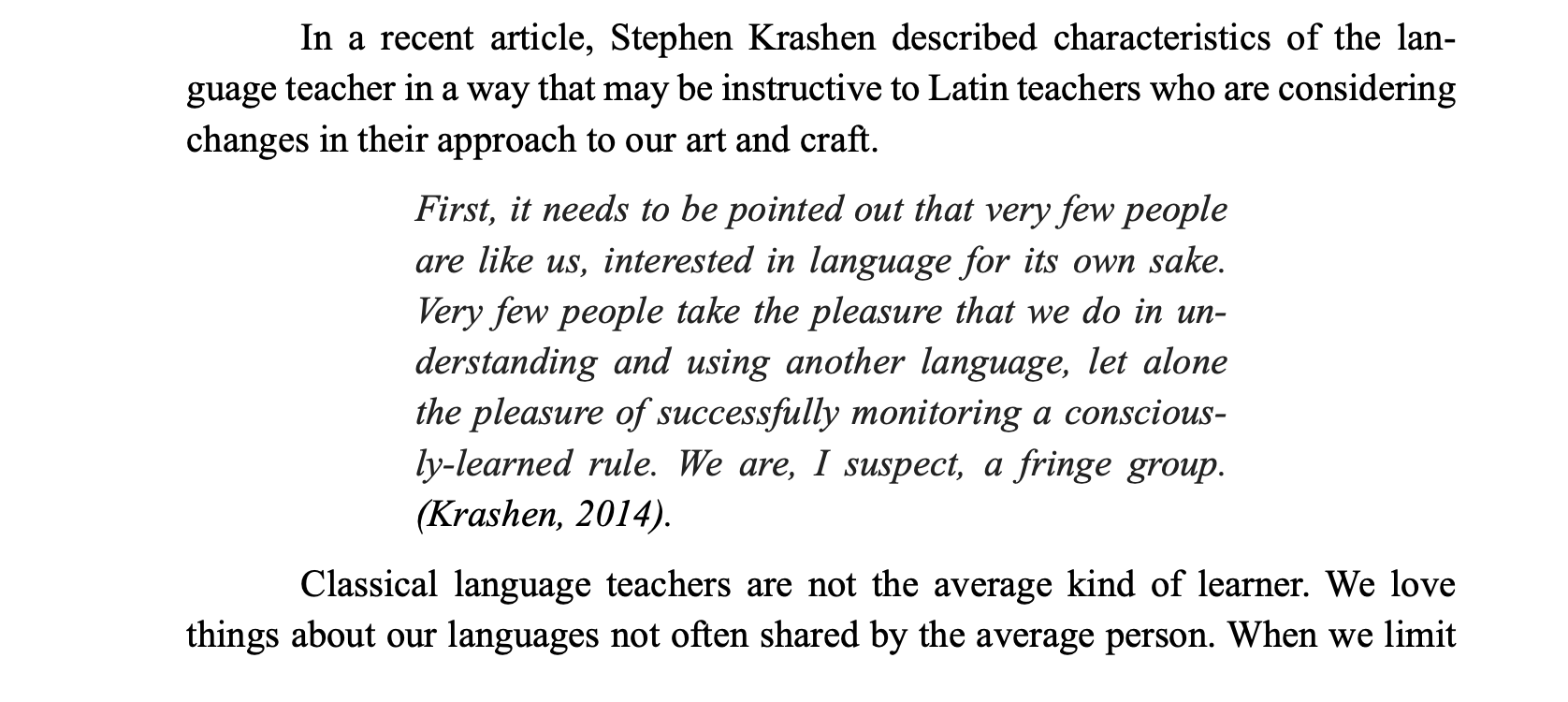
Taken from Robert Patrick’s “Making Sense of Comprehensible Input in the Latin Classroom.” Teaching
Classical Languages 6.1 (Spring 2015): 108-136. ISSN 2160-2220.
What did he say….? A “fringe group”? And we loved things that were “not often shared by the average person”? It stung a bit. I mean, I loved Latin and Greek. Maybe, for some people, these languages came along at a time in their lives when the social landscape was ever changing around them. Maybe, in those awkward years, Latin was a refuge of clarity in a sea of social cues gone awry. I already knew I wasn’t normal (ha! normal). But… could that actually be affecting how I taught the things I loved? (silence)
Well, when you teach, you teach all of the students, so I had to admit that most of my students truly did not enjoy memorizing and applying endings. The textbook approach alone was not really interesting to them. And if I wanted to teach for the long term, then I wanted it to be engaging for the long term, for them and for me. And if I wanted them to have a chance at loving Latin even a teeny weeny little tiny bit, then I needed to change the way that I taught.
My first stop was Latin novellas, a booming field of texts, irregular in quality at times, but really helpful as a first step away from the textbook. Through links and blogs I found the novellas by Andrew Olimpi . These witty and simple Latin novellas remain a constant presence in my classroom even now, six years later.
And this school year, one of my 8th grade classes chose my favorite Olimpi novella to end the school year, Ego, Polyphemus. It’s fitting, with the new Odyssey movie coming out this summer, that we conclude with Odysseus. Ah, but not Odysseus as Homer sees him, but as Polyphemus sees him, with that particular unity of vision native to cyclopes.
And we get see the softer side of Polyphemus- would-be lover, poet…. and of course, rage-eater of hominēs Graecōs when he has a bad day.
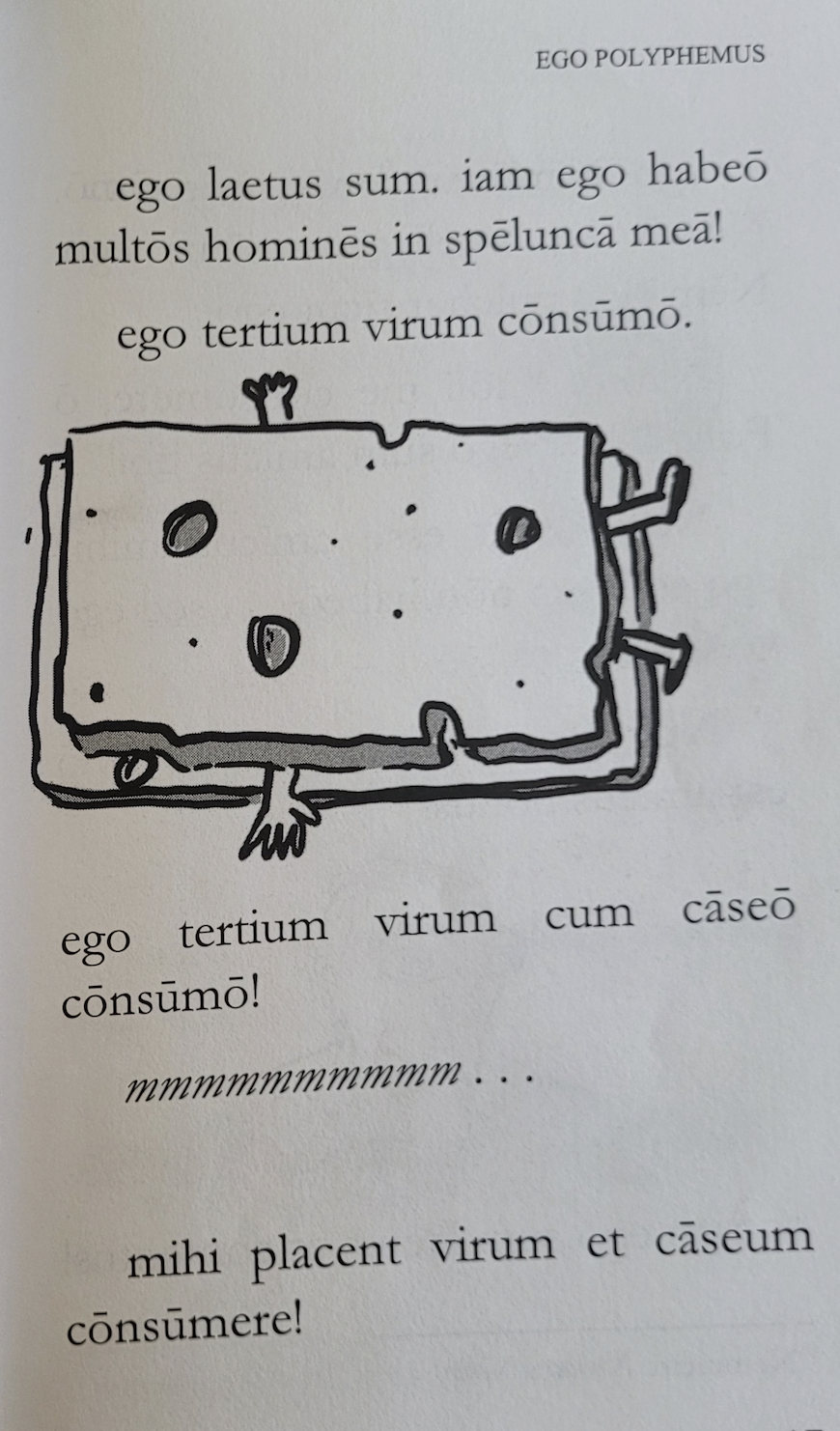
The first time I read this book with students, something happened that had never taken place before: students understood most of what they were reading, they understood the humor in Latin, and they kept reading because they wanted to see what happened next. This book laid the groundwork for some self- reflecting principles that I have continued to research, learn at conferences, and find on webinars and zoom calls when I can:
1) What else can I have the students do to show comprehension, besides translate from Latin into English?
2) How many different ways can I review the same words while maintaining a high level of engagement (ie review without the students realizing it’s review)?
3) How can the lesson be so engaging, that students forget that they are speaking (or reading, or writing) in Latin?
From Virgil to Polyphemus, it has been a good year. And yes, I’m ready for summer!
Doings at the Robert Louis Stevenson Museum
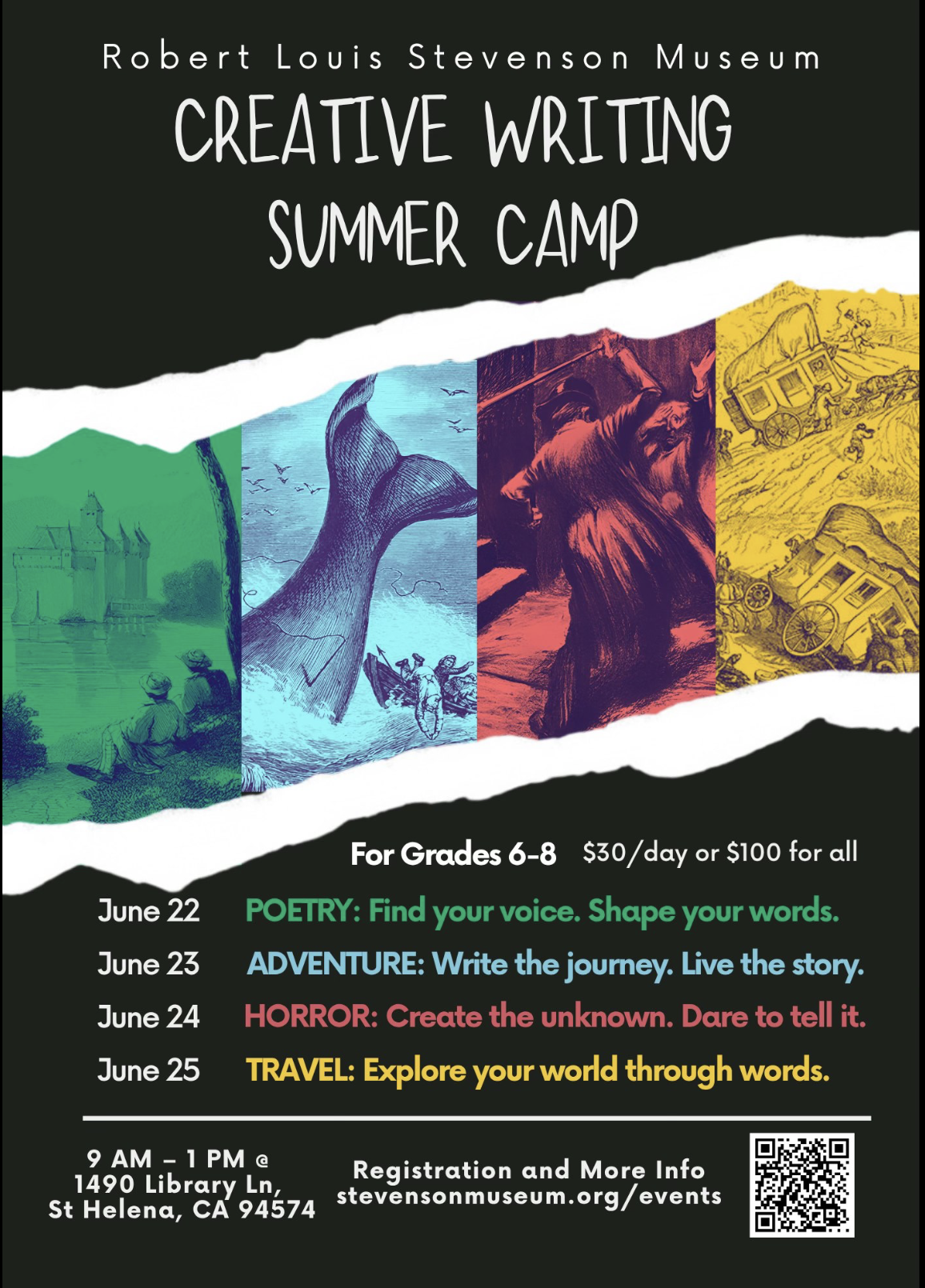
We have so many resources in St. Helena, including the fabulous collection at the Robert Louis Stevenson Museum. I’m excited to help with developing this first-of-a-kind program for young writers, and on a tip from Stevenson scholar Dr. Trenton Olsen, began to research Stevenson’s advice on the subject. I found his principles distilled on this informative website, together with a discussion of the pros and cons of Stevenson’s approach. It is my hope to incorporate the most helpful elements into the camp next month.
Second Novel Update!
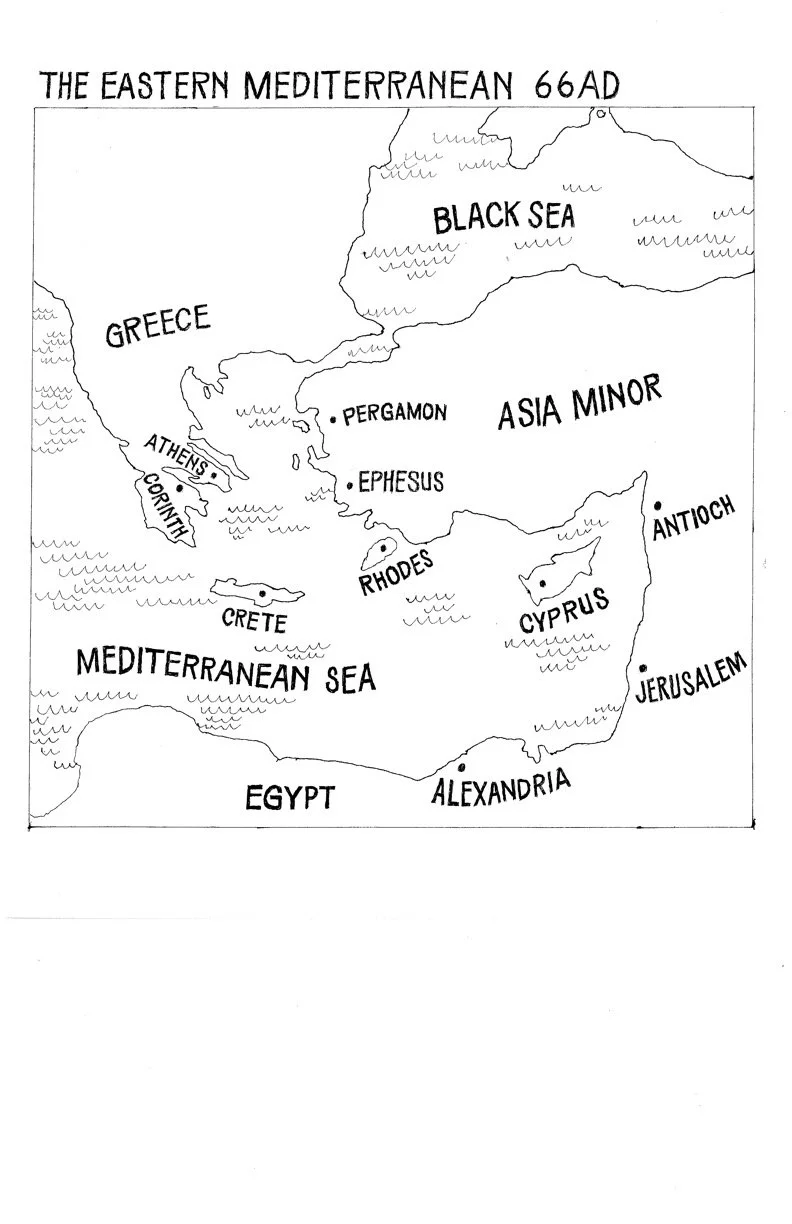
I spent a few summers and part of last fall working away at my second novel, Faelan and the Fall of the Gods. I’m happy to report that it is off at the publisher, who is preparing to release it in February of 2027! When I asked readers what they would like to see in the next Faelan book, many said that a map would be helpful. So I worked with friend and artist Nick Cann to include this map, which will help the reader track Faelan’s adventures. Looking forward to seeing the whole project in print!
A Year In Media (Res)
Faelan and the Miracle Machines was released one year ago, and one of the things I’ve most enjoyed is discussing various book-related topics, including history, teaching, Latin, and storytelling. I’ll eventually pin all off these interviews and talks to my Publications page, but I thought it would be good to capture the progress of the past year in a post.
Living Latin in New York
Happy to share that I will be one of the Latin-speaking presenters at the Paideia Institute In February of 2025!
Click on the link for more information: https://www.paideiainstitute.org/living_latin_in_new_york_city

A Manifesto for Ugly Times
I had been working on this piece for a few years, and it finally came together. I tried to shop it around to various publications, but it hasn’t found a home. Not great? Not good? Not partisan enough? Anyway, there are probably more photographs embedded in it than anyone wants to include in an article. So I headed over to Medium, which I haven’t written on in ages, and here it is: my political manifesto for Election 2024.

Book Signing in Napa
Hi friends! I’ll be in Napa at Copperfield’s Books on July 14th. Looking forward to signing books and visiting!

Heron of Alexandria
We tend to think of the modern age as the age of machines, but once we delve into evidence from the ancient world, we see that machine innovation has been an element of civilization for millennia. The invention of machines in the Greco-Roman world was generally the realm of philosophers, who created their machines as an outgrowth of their inquiry into the forces of the natural world and mathematics. That is, philosophers, who were concerned with a wide range of subjects that we have since compartmentalized into various academic professions (mathematician, physicist, astronomer, etc.), did not pursue making machines as their primary goal. So calling Archimedes or Heron an inventor only represents part of their work. They generally created machines to show how the elements (wind, air, fire, water) worked and could be harnessed to augment human activity, whether in everyday life or in warfare.
Archimedes is one of the most famous philosophers from the ancient world. Some of his most famous inventions were the Archimedes Screw and the Claw of Archimedes.
The Archimedes Screw is still in use today around the world.

Kinderdijk, modern Archimedes' screw in a Pumping station in Kinderdijk, The Netherlands. Picture by M.A. Wijngaarden. (via Wikipedia)

Graphic of the Archimedes Screw, created by Silberwolf (size changed by: Jahobr)
Heron, who lived in Alexandria in the first century AD, was also a philosopher whose creations tested the forces of nature. One of his most famous inventions that harnessed fire, air and water, was the steam engine. In a world where slave labor dominated and slaves outnumbered free citizens 2:1, this machine never found a practical use. (As an aside, what if it had? That, my reader, is a subject for an alternate history book! Go for it, it’s not my genre). Like Archimedes, Heron created machines that had practical and military uses. He also, however, seems to have had a theatrical side- that is, he created amazing automata, the primary purpose of which was entertainment. These devices worked on their own and told a story. Often, they wheeled themselves on and off stage. It was important for Heron that the theater be set on a slender pedestal or stand so that the audience could see that no tiny human was inside, working the machine!
This model, created by Prof. Richard Beacham and Janis Atelbauers, demonstrates how the theater worked. Powered by weights and a complex network of ropes wound around dowels, the system of the automatic theater is widely recognized as the first computer program.
These powers of intellect and imagination, coupled together, serve as one of my inspirations in writing. The philosophers of the ancient world did not view their work through the lens of limitation. We are easily surprised by how much they accomplished because we often view their world as simple and crude. In reality, their innovations have accompanied and inspired those of our age.